Recent Reviews
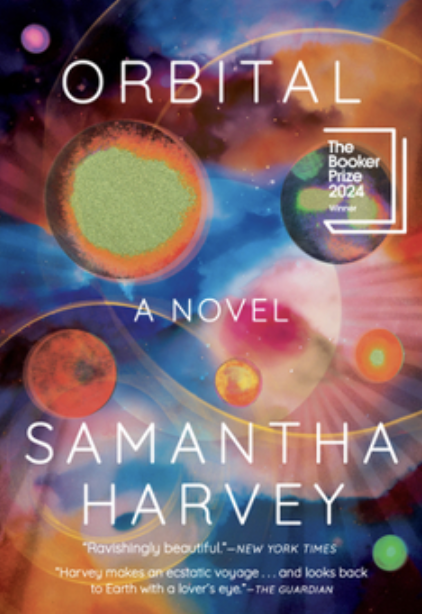
Orbital by Samantha Harvey
When my friend Sara gave me Samantha Harvey’s novel Orbital, I must admit I was a bit skeptical. I don’t usually gravitate toward books about space exploration. Yet Orbital is a beautiful read, filled with reverence and respect for our planet. Unique in both structure and content, I understand why the book was awardedthe 2024 Booker Prize.
Four men and two women are at a fictionalized version of the International Space Station on one of the last missions before the program is dismantled. They are from America, Britain, Italy, Japan, and Russia. Though long for their lives on Earth, none would miss this opportunity to be in space. Observing the gorgeous blue planet that is home is almost intoxicating.
The book is driven neither by plot nor by extensive character development. Each of the astronauts have introspective contemplations but the true focus is the awe they feel as they view Earth from the International Space Station. Harvey offers many philosophical observations about the fragility of existence and the vastness of space. Shaun, one of the astronauts, captures this perspective: “We’re windblown leaves. We think we’re the wind, but we’re just the leaf.”
Over the course of twenty-four hours, they slip through time zones as they circle Earth sixteen times: sixteen spectacular sunrises and sixteen spectacular sunsets. Harvey’s detailed descriptions of the astronauts observing the planetfrom space are stunning. Land masses seem to merge, and the distinctions between countries disappear—except on computerized maps that impose those divisions.
This book reads more like a personal essay, a poem or a prayer than a conventional novel. There are many compelling philosophical meditations but ultimately the story is a moving plea to respect and revere this Earth we humans share. 4/5

Kin by Tayari Jones
Tayari Jones’s novel Kin follows two young girls who yearn for their missing mothers while finding comfort in their lifelong friendship. As in her previous novels, Jones explores families formed not by biology or duty, but through love and commitment. She writes deftly about bonds that are deep, unbreakable, and true. The novel is filled with wit, intelligence, and a profound understanding of the bonds between women. Her characters’ dialogue feels both authentic and lyrical, and with restraint she captures the brand of sexism, racism, and classism that permeated the American South in the 1950s.
The story begins in Honeysuckle, Louisiana, where Annie and Vernice (Niecy) are born to neighboring families. Soon, both infants are motherless: Annie’s mother is killed by her father, and Vernice’s mother abandons her while she is still an infant. Other family members step into the breach, and the girls are raised as “cradle friends.”
The girls remain inseparable through high school, sharing their yearning for the mothers they never knew. Their lives then take different paths. Niecy enrolls at Spelman College and becomes part of a powerful sisterhood of Black women, while Annie travels to Nashville, determined to find the mother who deserted her. Both young women struggle with feelings of loss and abandonment. Although their divergent paths create a class divide between them, they remain loyal to one another.
Jones does not dwell on the persistent racism of the world in which the girls live, but bigotry is ubiquitous. Toward the end of the novel, however, the emerging Civil Rights Movement comes into focus.
Jones has written a beautiful book about two girls who become kin to one another. Because their bond is rooted not in biology or obligation, but in a shared history, it is even stronger. Even when that bond is tested, Niecy and Annie’s connection remains unbroken. Kin is a moving exploration of the love that connects people. 4/5

A Far-Flung Life by M.L. Stedman
Over a decade has passed since the release of M. L. Stedman’s engrossing debut novel, The Light Between Oceans. Her new novel, A Far-Flung Life, was well worth the wait. Stedman writes with empathy and compassion for the moral conundrums her characters face. The novel explores how people live in the aftermath of tragedy, the secrets they hold close, and the ways love and sacrifice can mend wounded souls.
This multigenerational story begins in 1958 in isolated Merideth Downs, a one-million-acre sheep station in Western Australia. Though the land is vast and beautiful, its ever-changing weather patterns and intrusive wildlife are unforgiving. Generations of the McBride family have farmed sheep in this rural area since 1829. Details of every birth, marriage, death, weather event and sheep activitiees are recorded in logbooks, creating a constant sense of the family’s place in both the past and future of the station. The McBride’s closest neighbors live at another sheep station 100 miles away.
Phil and Lorna McBride have three children. One day, while Phil is driving with his two sons, he swerves to avoid a kangaroo and crashes. Phil and his eldest son, Warren, are killed, while the youngest, Matt, is badly injured. Despite their profound grief, Lorna and her daughter, Rosie, try to carry on as they tend to Matt and hope for his survival. Matt does survive, though he doesn’t completely heal.
That fiery crash sparks a series of events that alter the lives of the three remaining McBrides. As the narrator observes, “It’s a reminder that solid ground, unchanged for millions of years, can rearrange itself without warning or permission. You just have to live with the new terrain. Repair what roads and fences you can. Start from scratch for the rest of it.”
At this point in the story, a disturbing plot thread emerges, and those involved must decide how to proceed. Stedman navigates this thread with sympathy, not judgment. In the hands of a less skilled writer, the book might be too difficult to read. But with Stedman’s skill and insight, the story becomes a message of acceptance, understanding, and love. These are good people wrestling with major moral dilemmas and balancing self-sacrifice with happiness.
In addition to the McBride family, other characters harbor secrets that the community considers taboo. Yet these characters are steady, conscientious members of that community, while the few folks who behave badly appear small and petty by comparison.
What Stedman’s novel conveys is that if we knew what another person has endured, we might never judge anyone harshly. The story is filled with instances of good people trying to protect those they love.
As I finished the last page, I felt appreciation for this beautiful book, which shows deep respect and understanding for the complexities of being human. M. L. Stedman’s A Far-Flung Life is both heartbreaking and hopeful. Highly recommend. 5/5
